
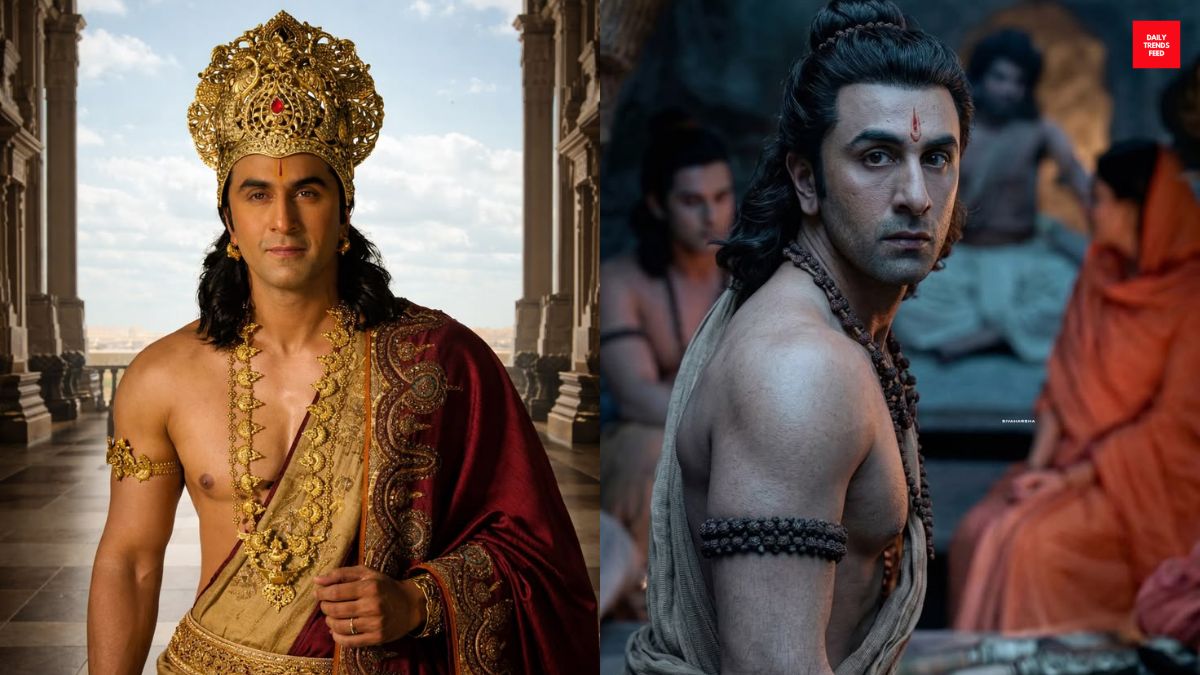
There is expensive. Then there is Baahubali expensive. And then there is whatever Ramayana is doing — which is an entirely different financial universe.
Nitesh Tiwari’s two-part epic starring Ranbir Kapoor, Yash, and Sai Pallavi has been making headlines not just for its cast or story, but for a budget figure that has left the entire film industry speechless.
We are talking about numbers that rival Hollywood blockbusters, dwarf every Indian film ever made, and raise a very serious question — can any Indian film ever earn this money back?
Ramayana movie budget is reportedly one of the highest in Indian cinema history. Here’s what the money is going into and how it compares to RRR, Kalki 2898 AD and Baahubali.
What Is The Ramayana Movie Budget?
This is where things get interesting — because depending on which report you read, the number changes dramatically.
According to Bollywood Hungama, sources close to producer Namit Malhotra confirm that Ramayana’s two parts are being crafted with a combined budget of ₹1,600 crore, excluding print and publicity costs.
The breakdown is ₹900 crore for Part 1 and ₹700 crore for Part 2 — with the cost difference because most of the sets, costumes, and VFX assets built for Part 1 will be reused in Part 2, significantly reducing expenses.
However, that is the conservative estimate.
Other reports place the total budget for both parts — from shooting to release — at approximately ₹4,000 crore.
At roughly $500 million, the Ramayana budget at its highest estimate dwarfs most Indian productions and rivals or exceeds several Hollywood heavyweights.
So which number is correct? The truth is likely somewhere in between — and even the lower figure of ₹1,600 crore makes Ramayana the most expensive Indian film franchise in history by a significant margin.
Where Is All This Money Going?
A budget this large does not just come from star fees — though those are substantial too (Ranbir alone is reportedly earning ₹150 crore across both parts). Here is what the production is spending on:
VFX — The Biggest Chunk
VFX is being handled by DNEG Studios — the Oscar-winning team behind Dune, Inception, and Avengers: Endgame. Action choreography is being led by Guy Norris, the legend behind Mad Max: Fury Road.
A significant portion of the budget is dedicated to visual effects. Handled by DNEG, the same studio responsible for the visual wizardry in Interstellar and Dune, the film aims to set a new global benchmark.
This is a direct response to the Adipurush disaster of 2023, where poor CGI destroyed audience trust despite a massive budget. The Ramayana makers are clearly not making the same mistake.
Sets, Costumes and Production Design
Part 1 alone covers elaborate sets, character designs, and digital assets for Ayodhya, Lanka, and beyond. The film relies heavily on advanced VFX, with elaborate sets built in Mumbai studios and additional shoots in London.
The Music Collaboration
In a historic move for Indian cinema, Hollywood legend Hans Zimmer made his Indian debut on this film, collaborating with A.R. Rahman to create a sonic experience that matches the visual scale.
Two Oscar-winning composers working together on a single soundtrack does not come cheap.
Global Distribution
Warner Bros. Pictures is handling global distribution for Ramayana — another first for Indian cinema.
The makers plan to release the film in 30–50 languages using an AI-powered strategy for both local and international markets, and Ramayana could be the first Indian film to target a release in over 190 countries.
How Does It Compare To Every Other Big Indian Film?
Here is the comparison that puts everything in perspective:
| Film | Budget |
|---|---|
| Ramayana (both parts) | ₹1,600–4,000 Cr |
| Kalki 2898 AD (2024) | ₹600 Cr |
| RRR (2022) | ₹550 Cr |
| Adipurush (2023) | ₹500–700 Cr |
| Baahubali 1 + 2 (combined) | ₹430 Cr |
| Brahmastra (2022) | ₹400 Cr |
| Dangal (2016) | ₹100 Cr |
The ₹4,000 crore budget dwarfs all previous Indian productions.
Even considering Ramayana is two films, the cost far exceeds the combined budgets of Adipurush (₹550 crore), RRR (₹500 crore), and Kalki 2898 AD (₹600 crore) — all of which are single films.
The closest comparison in India is the Baahubali series, which had a combined budget of ₹430 crore — just about a ninth of Ramayana’s projected cost.
Even by Hollywood standards, this is serious money.
Films like Avatar: The Way of Water and Avengers: Endgame operated in the $350–400 million range — putting Ramayana’s upper budget estimate at or above those global blockbusters.
The Elephant In The Room — Can It Make This Money Back?
This is the question every trade analyst is asking right now.
Industry observers are closely watching whether the film’s massive scale can translate into box office success capable of recovering such staggering costs.
For perspective, Aamir Khan’s Dangal — currently among the highest-grossing Hindi films ever — earned over ₹2,000 crore worldwide in its lifetime run.
That means even Dangal’s entire lifetime collection would not cover Ramayana’s production budget at the ₹4,000 crore estimate.
However, there are reasons to be optimistic:
1. The subject matter. Ramayana is not just a film — it is a cultural event. The story of Ram and Sita is embedded in the DNA of over a billion people across India and Southeast Asia. No other story has this built-in emotional audience.
2. The two-part structure. Like Baahubali, the two-film model means double the box office opportunities. If Part 1 succeeds, Part 2 opens even bigger.
3. Global ambition. With Warner Bros. distributing in 190 countries and 30–50 language versions, Ramayana is not just targeting India. It is going after the global Indian diaspora and international curiosity markets simultaneously.
4. IMAX premium. Both parts are shot for IMAX, meaning higher ticket prices across every major market.
The Adipurush Warning
No article about Ramayana’s budget is complete without addressing the elephant that already stumbled into this space — Adipurush (2023).
That film told the same story. It had a massive budget of ₹500–700 crore.
And it was brutally rejected by audiences for CGI that looked worse than a video game, dialogue that felt disrespectful to the source material, and a creative vision that missed the emotional core entirely.
The Ramayana team is clearly aware of this.
Every production decision — DNEG for VFX, Guy Norris for action, Hans Zimmer for music, Nitesh Tiwari (of Dangal, Chhichhore fame) directing — signals a team that is trying to do this right, not just big.
Whether they have succeeded, we find out on November 8, 2026.
Stay tuned to Daily Trends Feed for all Ramayana updates — trailer breakdown, box office predictions, and cast updates.
Lead Image: Prime Focus, India Today
Also Read:
Ramayana OTT Deal: Namit Malhotra Rejects Rs 700 Crore Offer, Eyes Rs 1000 Crore